Plate 014 — Wargames
REF: BF-GME-014Battleship Game WW2: A Turn-Based Naval Strategy Game
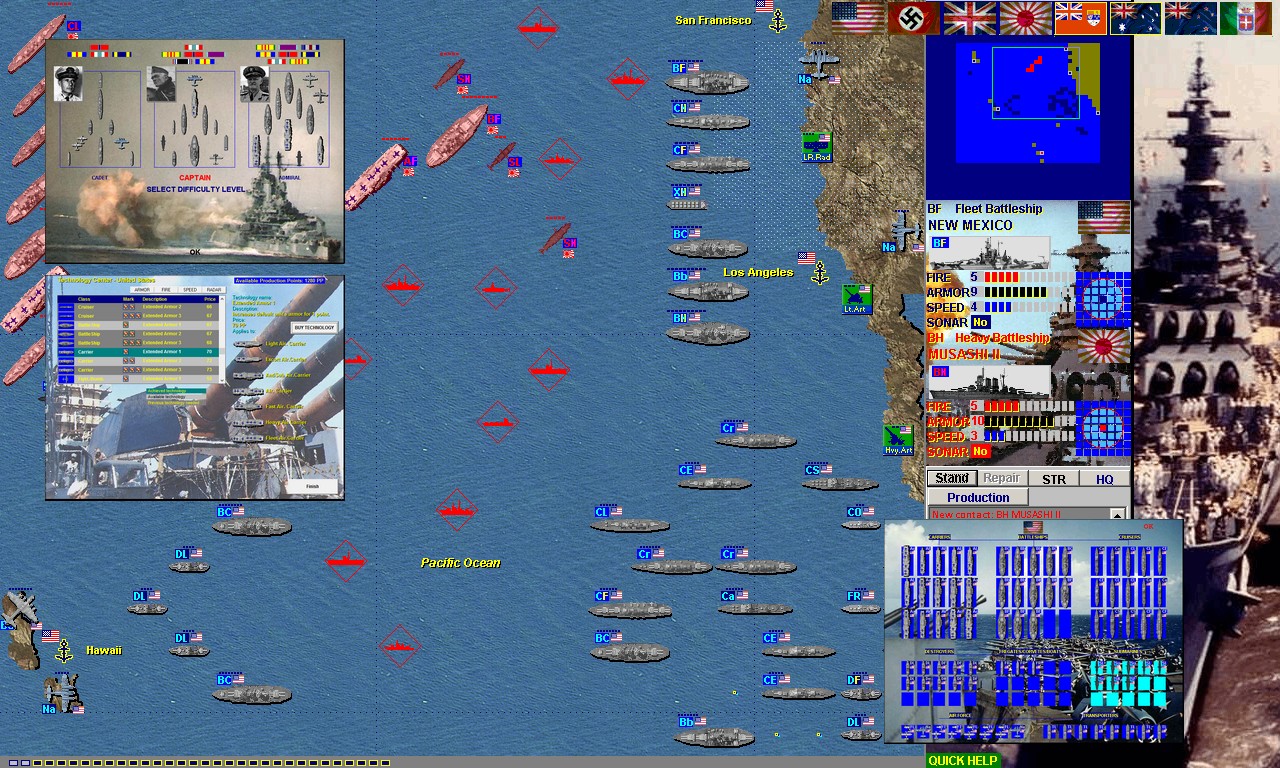
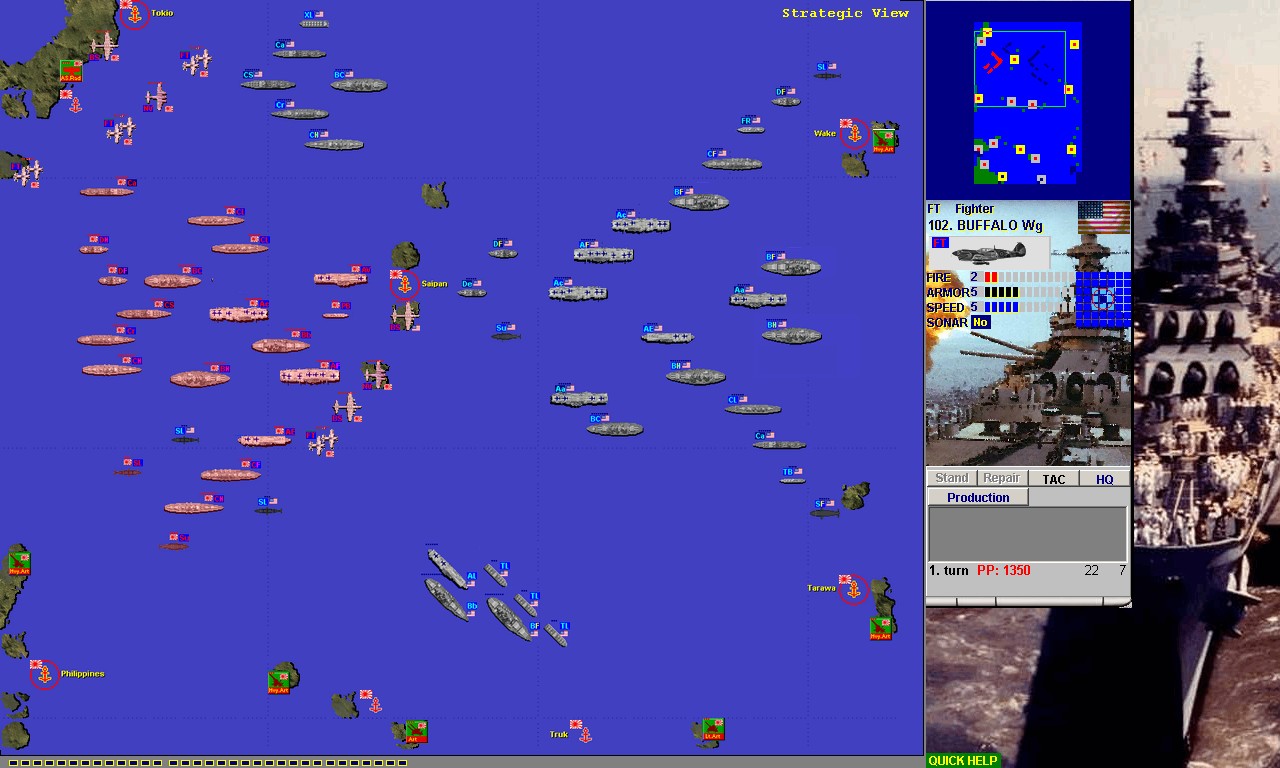
Battleship Game WW2 turned the classic board game into a full Pacific war campaign, letting ships, submarines and aircraft move across maps as large as 96x96 squares with more than fifty purchasable unit types.
Play Battleship against the computer
Five ships a side on a 10 × 10 chart: carrier (5 squares), battleship (4), cruiser (3), submarine (3) and destroyer (2). Each salvo is answered by one from the computer, which hunts on a checkerboard pattern and closes in along the line once it has two hits.
Own fleet
Enemy waters
The game loads when this section scrolls into view; it needs JavaScript.
Battleship Game WW2 was a turn-based naval strategy title built around the full span of the Second World War at sea, from Pearl Harbor to the closing battles in the Pacific. Where classic Battleship, playable as a grid on this site, confines its fleet to a single fixed 10x10 board, Battleship Game WW2 let ships, submarines and aircraft move across a much larger battlefield map while keeping the same core idea of a hidden fleet under fire.
Setting and Playable Navies
The game covered every major navy that fought at sea during the war: the United States Navy, the Kriegsmarine, the Imperial Japanese Navy, the Royal Navy, the Royal Canadian Navy, the Royal Australian Navy, the Royal New Zealand Navy and Italy's Regia Marina. A player could take command of any of these fleets or fight against a computer-controlled one.
The campaign followed the Pacific war roughly in order, opening with Pearl Harbor and Midway and running through to the fighting around Iwo Jima and Leyte. All unit names and officer ranks used in the game were drawn from history rather than invented for the occasion.
Missions, Death-Match and Free Hunt
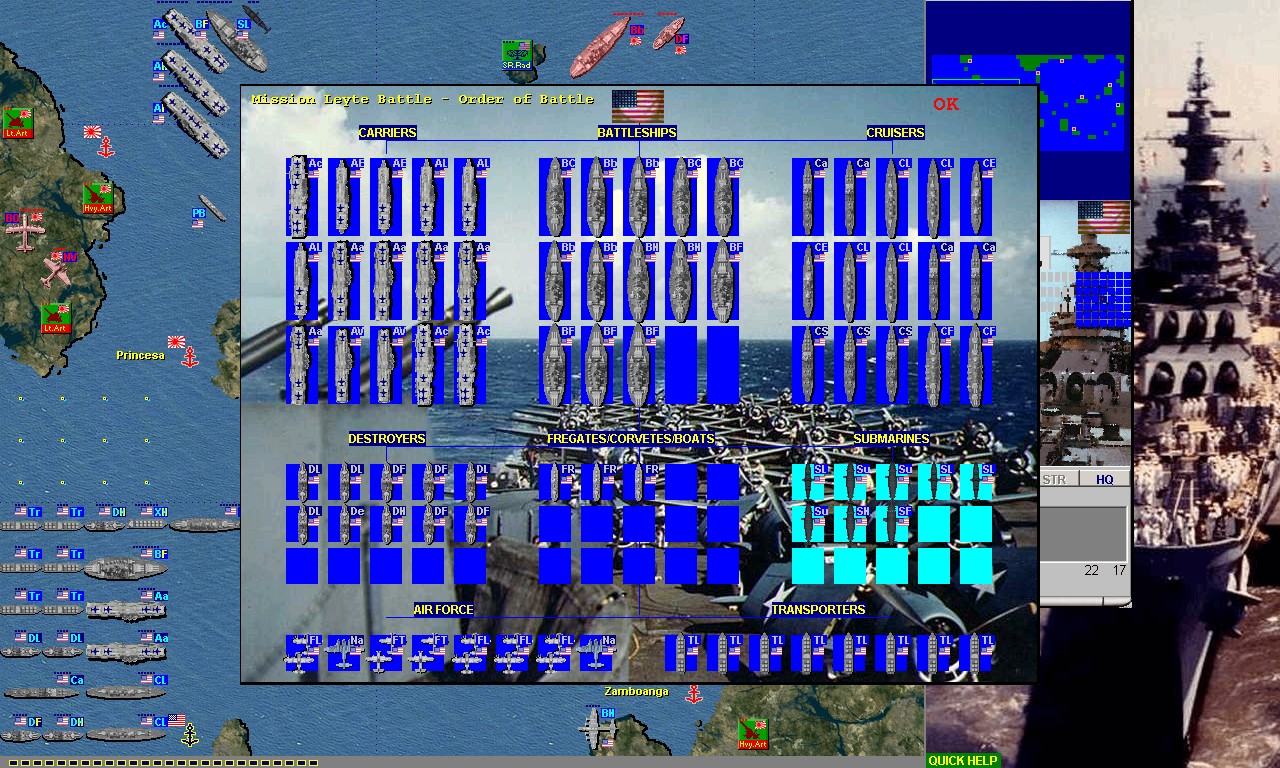
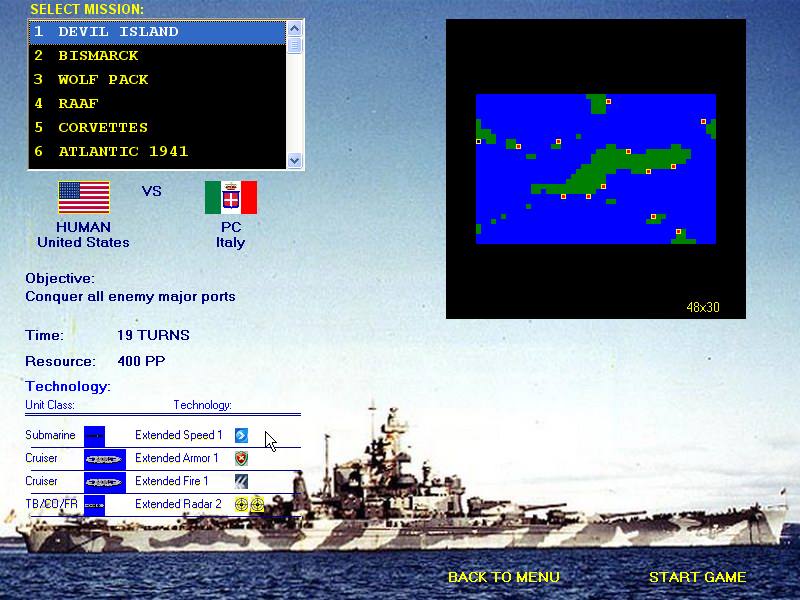
Beyond the linear campaign, the game offered a large set of standalone missions, Death-Match battles and Free Hunt scenarios built around specific historical engagements. Named scenarios included Bismarck, Atlantic 1941, Midway, Coral Sea, Leyte, Iwo Jima, Singapore, Norway Convoy and the Fall of Australia, alongside battles named for individual commanders such as Tovey, Spruance and Halsey.
Each mission set one of the following objectives:
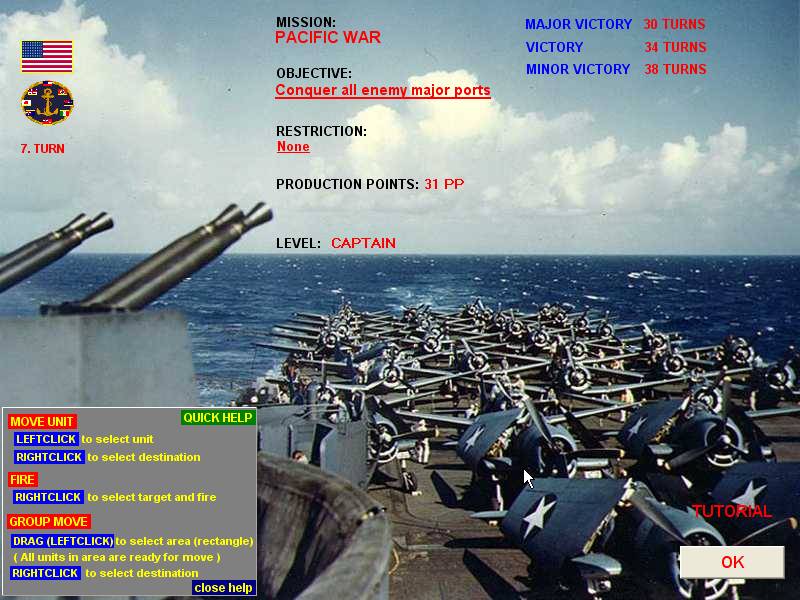
- Conquer all enemy major ports
- Defend friendly ports for a set number of turns
- Destroy a target number of a specific class of enemy ship
- Eliminate as many enemy combat or transport ships as possible within a turn limit
- Escort a transport convoy safely to a friendly port
Units, Purchases and Technology Research
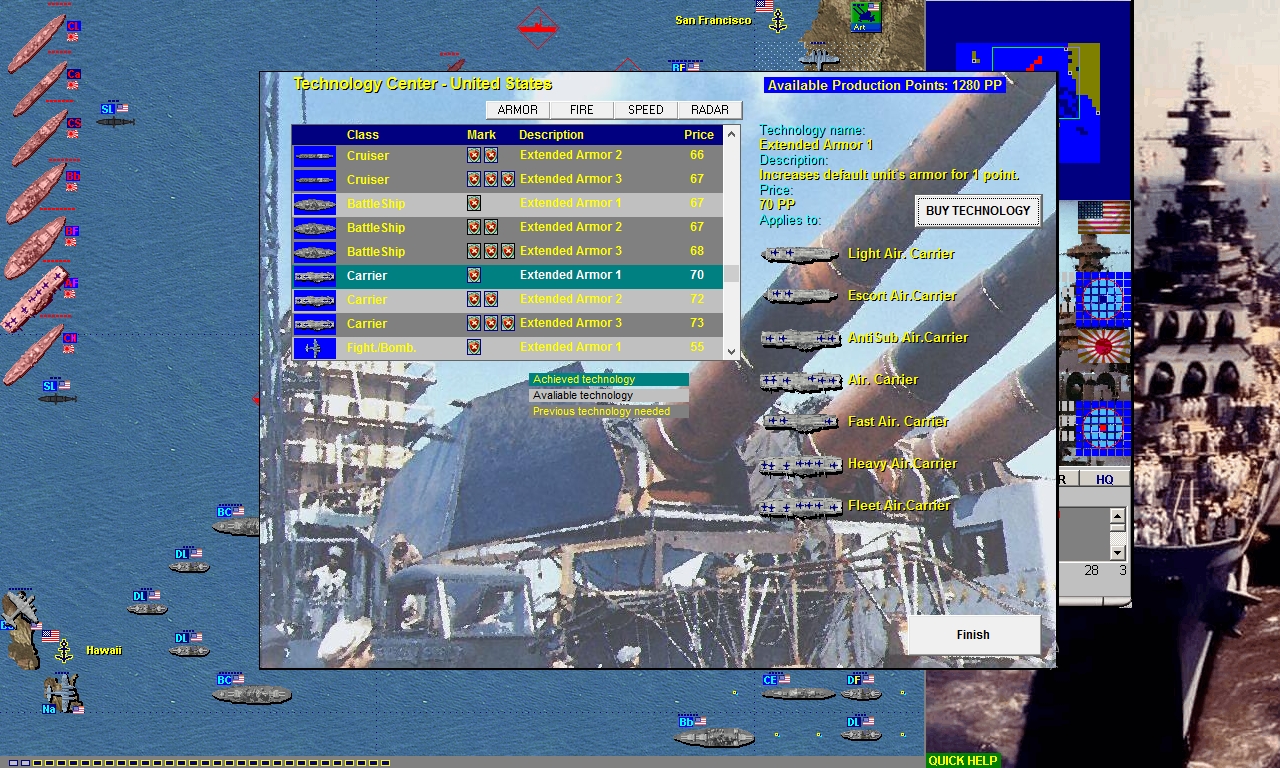
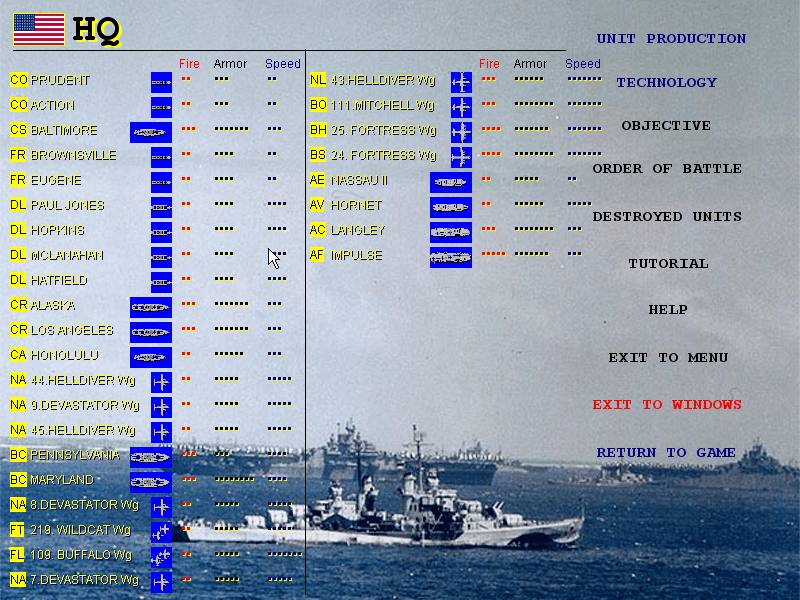
Players could purchase new ships and aircraft during a mission rather than starting with a fixed fleet, drawing from more than fifty unit types across the following categories:
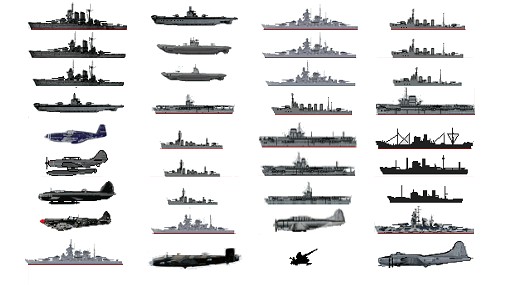
- Aircraft carriers: fleet, heavy, fast, medium, light, escort and anti-submarine variants
- Cruisers and battleships: fleet, heavy, medium and anti-submarine variants, plus a battlecruiser class
- Submarines and destroyers: heavy, medium and light classes, plus frigates, corvettes, patrol boats and torpedo boats
- Air units: strategic bombers, heavy bombers, bombers, long-range naval aircraft and fighters
- Support units: heavy, medium and light transports, plus port artillery and radar in short, standard and long-range classes
Production Points earned during a mission could also be spent researching Extended Armor, Extended Fire, Extended Speed and Extended Radar Range technologies. Once purchased, an upgrade applied immediately to every unit of that class already on the map and to any future unit built in the same class for the rest of the game.















Rank Progression
The game tracked a player's career through 224 WW2-era ranks: ten non-commissioned grades and eighteen commissioned grades for each of the eight playable navies. A single mission or Free Hunt scenario only exposed the lower end of that ladder, from Recruit up to Lieutenant (Junior); working through a full campaign and achieving at least a minor victory in every mission was required to reach the higher commissioned ranks.
How It Extended the Classic Battleship Rules
Battleship Game WW2 kept the hidden-fleet-and-guessing concept of the board game but changed nearly everything else about how a match played out. Compared with the standard rules of classic Battleship, it differed in eight main ways:
- Ships can move instead of sitting fixed in one square
- Ships have a radar range, so a unit can only find and fire on enemies within range of its own position, rather than anywhere on the map
- The battlefield map can measure up to 96x96 squares, far larger than the standard 10x10 grid
- Players choose among fifty ship, submarine, aircraft, port-artillery and radar unit types instead of five fixed ships
- Maps include land, islands, and both major and minor ports
- Mission objectives vary rather than always being to sink every enemy ship
- Missions run under a time limit
- Players can purchase new ships and aircraft while a mission is in progress
The death-match format simplified this back down to a single objective: destroy all enemy units, including ships, planes and artillery. Campaign play was stricter still, requiring at least a minor victory in every mission along the way. The same production-and-movement approach was carried further in BattleFleet 1939 and BattleFleet: Pacific War, both covered separately on this site.
System Requirements
| Requirement | Detail |
|---|---|
| Operating system | Windows 95, 98, 2000, XP, NT, ME, Vista or 7 |
| Hardware | Standard PC configuration of the period |