 |
|
| F18 | F-18 |
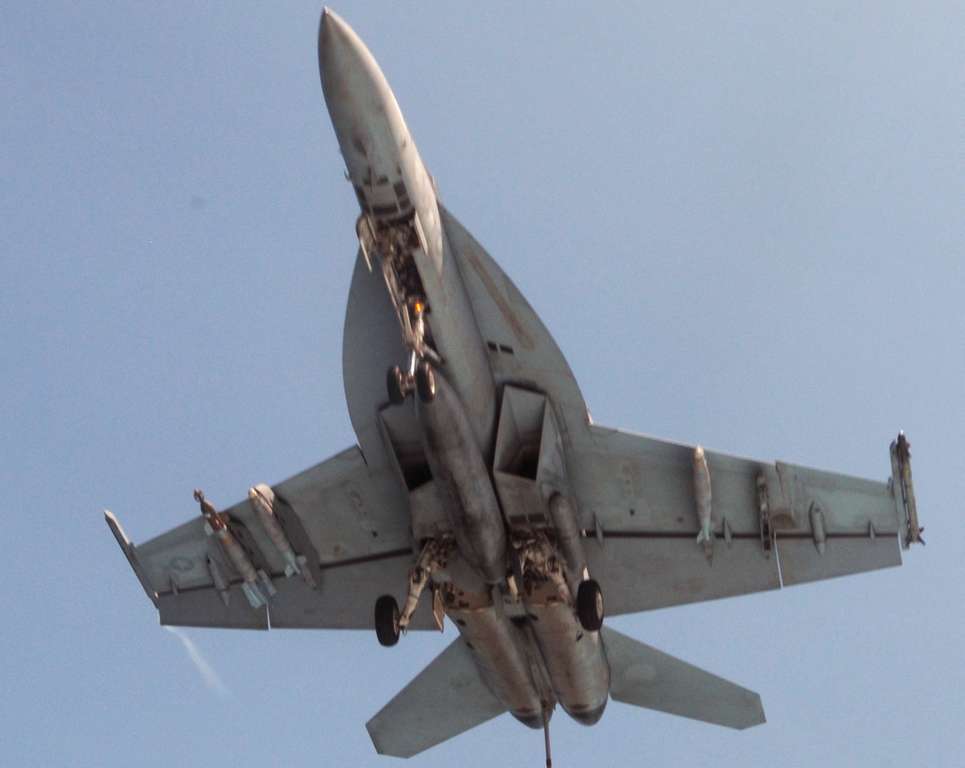
F18 Description:
All-weather fighter and attack aircraft. The single-seat
F/A-18 Hornet is the nation's first
strike-fighter. It was designed for traditional strike
applications such as interdiction and close air support
without compromising its fighter capabilities. With its
excellent fighter and self-defense capabilities, the
F/A-18 at the same time increases strike mission
survivability and supplements the F-14 Tomcat in
fleet air defense. F/A-18 Hornets are currently
operating in 37 tactical squadrons from air stations
world-wide, and from 10 aircraft carriers. The Hornet
comprises the aviation strike force for seven foreign
customers including Canada, Australia, Finland, Kuwait,
Malaysia, Spain and Switzerland.
The newest model, F18 Super Hornet, is highly
capable across the full mission spectrum: air
superiority, fighter escort, reconnaissance, aerial
refueling, close air support, air defense suppression and
day/night precision strike. Compared to the original
F/A-18 A through D models, Super Hornet has longer
range, an aerial refueling capability, increased
survivability/lethality and improved carrier suitability.
[Capability of precision-guided munitions: JDAM (all
variants) and JSOW. JASSM in the future]
| CIA / KGB intelligencegame. Run your own operation game. Travel around the world and set up espionage game, trade with state secrets, weapon systems, spy codes, WMD, hire secretaries, agents, lawyers and soldiers, establish secret agent stations, cells and bases and search for criminals and politicians. Involve in agent game. Game contains more than 40 missions including Nuclear Game, Cold War Game, Secret Agent, CIA Games, USAF, Prime Minister, RAF, Bin Laden, Sadam, KGB, Operations Iran… |
F18 Features: The
F/A-18 Hornet, an all-weather aircraft, is used as
an attack aircraft as well as a fighter. In its fighter
mode, the F/A-18 is used primarily as a fighter escort
and for fleet air defense; in its attack mode, it is used
for force projection, interdiction and close and deep air
support.
F18 Background: The
F/A-18 demonstrated its capabilities and versatility
during Operation Desert Storm, shooting down enemy
fighters and subsequently bombing enemy targets with the
same aircraft on the same mission, and breaking all
records for tactical aircraft in availability,
reliability, and maintainability.
Hornets taking
direct hits from surface-to-air missiles, recovering
successfully, being repaired quickly, and flying again
the next day proved the aircraft's survivability. The
F/A-18 is a twin engine, mid-wing, multi-mission tactical
aircraft. The F/A-18A and C are single seat aircraft. The
F/A-18B and D are dual-seaters. The B model is used
primarily for training, while the D model is the current
Navy aircraft for attack, tactical air control, forward
air control and reconnaissance squadrons. The newest
models, the E and F were rolled out at McDonnell Douglas
Sept. 17, 1995. The E is a single seat while the F is a
two-seater.
The F/A-18 E/F acquisition
program was an unparalleled success. The aircraft emerged
from Engineering and Manufacturing Development meeting
all of its performance requirements on cost, on schedule
and 400 pounds under weight. All of this was verified in
Operational Verification testing, the final exam, passing
with flying colors receiving the highest possible
endorsement.
The first operational
cruise of Super Hornet, F/A-18 E, was with VFA-115
onboard the USS Abraham Lincoln (CVN 72) on July
24, 2002, and saw initial combat action on Nov. 6, 2002,
when they participated in a strike on hostile targets in
the "no-fly" zone in Iraq.
Super Hornet, has
been flying combat sorties from Abraham Lincoln
during Southern Watch, demonstrating reliability
and an increased range and payload capability. VFA 115
embarked aboard Lincoln expended twice the amount
of bombs as other squadrons in their airwing (with 100 %
accuracy) and met and exceeded all readiness requirements
while on deployment. The Super Hornet cost per
flight hour is 40% of the F-14 Tomcat and requires
75% less labor hours per flight hour.
All F/A-18s can be
configured quickly to perform either fighter or attack
roles or both, through selected use of external equipment
to accomplish specific missions. This "force
multiplier" capability gives the operational
commander more flexibility in employing tactical aircraft
in a rapidly changing battle scenario. The fighter
missions are primarily fighter escort and fleet air
defense; while the attack missions are force projection,
interdiction, and close and deep air support.
The F/A-18C and D models
are the result of a block upgrade in 1987 incorporating
provisions for employing updated missiles and jamming
devices against enemy ordnance. C and D models delivered
since 1989 also include an improved night attack
capability. The E and F models have built on the proven
effectiveness of the A through D aircraft. The Super
Hornet provides aircrew the capability and
performance necessary to face 21st century threats.
There are two Super Hornet squadrons in the USS Nimitz (CVN 68) airwing: VFA 14 (F/A 18 E) and VFA 41 (F/A 18F). Nimitz has no F-14 Tomcats.
F-18 General Characteristics, Super Hornet, E and F models
Primary Function:
Multi-role attack and fighter aircraft
Contractor: McDonnell Douglas
Unit Cost: $ 57 million
Propulsion: Two F414-GE-400 turbofan engines
Thrust: 22,000 pounds (9,977 kg) static thrust per
engine
Length: 60.3 feet (18.5 meters)
Height: 16 feet (4.87 meters)
Maximum Take Off Gross Weight: 66,000 pounds
(29,932 kg)
Wingspan: 44.9 feet (13.68 meters)
Range:
Combat: 1,275 nautical miles (2,346 kilometers), clean
plus two AIM-9s
Ferry: 1,660 nautical miles (3,054 kilometers), two
AIM-9s, three 480 gallon tanks retained
Ceiling: 50,000+ feet
Speed: Mach 1.8+
Crew:
A, C and E models: One
B, D and F models: Two
Armament: One M61A1/A2 Vulcan 20mm cannon;
External payload: AIM 9 Sidewinder, AIM-9X
(projected), AIM7 Sparrow, AIM-120 AMRAAM, Harpoon,
Harm, Slam, SLAM-ER (projected),Maverick missiles;
Joint Stand-Off Weapon (JSOW); Joint Direct Attack
Munition (JDAM); Data Link Pod; Paveway Laser Guided
Bomb; various general purpose bombs, mines and rockets.
Date Deployed: First flight in November 1995.
Initial Operational Capability (IOC) in September 2001
with VFA-115, NAS Lemoore, Calif. First cruise for
VFA-115 is onboard the USS Abraham Lincoln.
F18
Variants
F18-A
The F/A-18A is the single-seat variant and the F/A-18B is
the two seat variant. The space for the two seat cockpit
is provided by a relocation of avionic equipment and a 6%
reduction in internal fuel; two-seat Hornets are
otherwise fully combat-capable. The B model is used
primarily for training.
In 1992, the original Hughes AN/APG-65 radar was replaced
with the Hughes (now Raytheon) AN/APG-73, a faster and
more capable radar. A model Hornets that have been
upgraded to the AN/APG-73 are designated F/A-18A+.
F18-C/D
The F/A-18C is the single-seat variant and the F/A-18D is
the two seat variant. The D-model can be configured for
training or as an all-weather strike craft. The
"missionized" D-model's rear seat is configured
for a Weapons and Sensors Officer to assist in operating
the weapons systems. The D model is primarily operated by
the U.S. Marine Corps in the night attack and FAC(A)
(Forward Air Controller (Airborne)) roles.
The F/A-18C and D models are the result of a block
upgrade in 1987 incorporating upgraded radar, avionics,
and the capacity to carry new missiles such as the
AIM-120 AMRAAM air-to-air missile and AGM-65 Maverick and
AGM-84 Harpoon air-to-surface missiles. Other upgrades
include the Martin-Baker NACES (Navy Aircrew Common
Ejection Seat), and a self-protection jammer. A synthetic
aperture ground mapping radar enables the pilot to locate
targets in poor visibility conditions. C and D models
delivered since 1989 also include an improved night
attack capability, consisting of the Hughes AN/AAR-50
thermal navigation pod, the Loral AN/AAS-38 NITE Hawk
FLIR (forward looking infrared array) targeting pod,
night vision goggles, and two full-color (previously
monochrome) MFDs and a color moving map.[3]
In addition, 60 D model Hornets are configured as the
night attack F/A-18D (RC) with ability for
reconnaissance. These could be outfitted with the ATARS
electro-optical sensor package that includes a sensor pod
and equipment mounted in the place of the M61 cannon.
Beginning in 1992, the F404-GE-402 enhanced performance
engine, providing approximately 10% more maximum static
thrust became the standard Hornet engine.[41] Since 1993,
the AAS-38A NITE Hawk added a designator/ranger laser,
allowing it to self-mark targets. The later AAS-38B added
the ability to strike targets designated by lasers from
other aircraft.
Production of the F/A-18C ended in 1999. In 2000, the
last F/A-18D was delivered to the U.S. Marine Corps.
The single seat F/A-18E and two-seat F/A-18F Super
Hornets carry over the name and design concept of the
original F/A-18, but have been extensively redesigned.
The Super Hornet has a new, 25% larger airframe, larger
rectangular air intakes, more powerful GE F414 engines
based on F/A-18's F404, and upgraded avionics suite. The
aircraft is currently in production and will eventually
equip 22 squadrons. The EA-18G Growler is an electronic
warfare version of the two-seat F/A-18F, which entered
production in 2007. The Growler will replace the Navy's
EA-6B Prowler.
[edit] Other US variants
F-18 (R)
This was a proposed reconnaissance version of the
F/A-18A. It included a sensor package that replaced the
20 mm cannon. The first of two prototypes flew in August
1984, however the variant was not produced.[40]
R F-18 D
Proposed two-seat reconnaissance version for the US
Marine Corps in the mid-1980s. It was to carry a radar
reconnaissance pod. The system was canceled after it was
unfunded in 1988. This capability was later realized on
the F/A-18D(RC).[40]
X-53, NASA's modified F/A-18.
T-F18 A
Two-seat training version of the F/A-18A fighter, later
redesignated F/A-18B.[6]
F-18 HARV
Single-seat High Alpha Research Vehicle for NASA.[43]
High angles of attack using thrust vectoring,
modifications to the flight controls, and forebody
strakes
X-53 Active Aeroelastic Wing
A NASA F/A-18 has been modified to demonstrate the Active
Aeroelastic Wing technology, and was designated X-53 in
December 2006.
F18 Export variants
These designations are not part of 1962 United States
Tri-Service aircraft designation system.
F-18L
This was a lighter land-based version of the F/A-18
Hornet. It was designed to be a single-seat
air-superiority fighter and ground-attack aircraft. It
was originally intended to be assembled by Northrop as
the export version of the F/A-18 Hornet. The F-18L was
lighter due to the removal of carrier landing capability.
Despite the advantages, customers preferred the
"ordinary" Hornet, and the F-18L never went
into production.
(A)F/A-18A/B
* (A)F/A-18A: Single-seat fighter/attack version for the
Royal Australian Air Force.
* (A)F/A-18B: Two-seat training version for the Royal
Australian Air Force.
"F/A-18A" was the original company designation,
designations of "AF-18A" &
"ATF-18A" have also been applied. Assembled in
Australia (excluding the first two (A)F/A-18Bs) by
Aero-Space Technologies of Australia (ASTA) from 1985
through to 1990, from kits produced by McDonnell Douglas
with increasing local content in the later aircraft.
Originally the most notable differences between an
Australian (A)F/A-18A/B and a US F/A-18A/B were the lack
of a catapult attachment, replacement of the carrier
tailhook for a lighter "land" arresting hook,
and the replacement of the automatic carrier landing
system with an Instrument Landing System. Australian
Hornets have been involved in a number of major upgrade
programs. This program called HUG (Hornet Upgrade) has
had a few evolutions over the years. The first was to
give Australian Hornets F/A-18C model avionics. The
second and current upgrade program (HUG 2.2) updates the
fleet's avionics even further.
C F-18 Hornet
* C F-18 A : Single-seat fighter/attack version for the
Canadian Forces. The Canadian Forces' official
designation is CF-188A Hornet.
* C F-18 B : Two-seat training and combat version for the
Canadian Forces. The Canadian Forces' official
designation is CF-188B Hornet.
F/A-18C of the Swiss Air Force taxis for takeoff
E F-18 Hornet
* E F18-A: Single-seat fighter/attack version for the
Spanish Air Force. The Spanish Air Force designation is
C.15.
* E F18-B: Two-seat training version for the Spanish Air
Force. The Spanish Air Force designation is CE.15.
KAF-18 Hornet
* KAF-18C: Single-seat fighter/attack version for the
Kuwait Air Force.
* KAF-18D: Two-seat training version for the Kuwait Air
Force.
F-18C/D Hornet
* The Finnish Air Force uses F/A-18C/D Hornets, with a
Finland-specific mid-life update. The first 7 Hornets
(D-models) were produced by McDonnell Douglas.[44] The 57
single-seat F-18C model units were assembled by Patria in
Finland.
F-18C/D Hornet
* Switzerland uses F-18C/D,[46] later Swiss specific
mid-life update. The Swiss F-18s were originally without
ground attack capability until hardware was retrofitted.
(credits: US Navy)